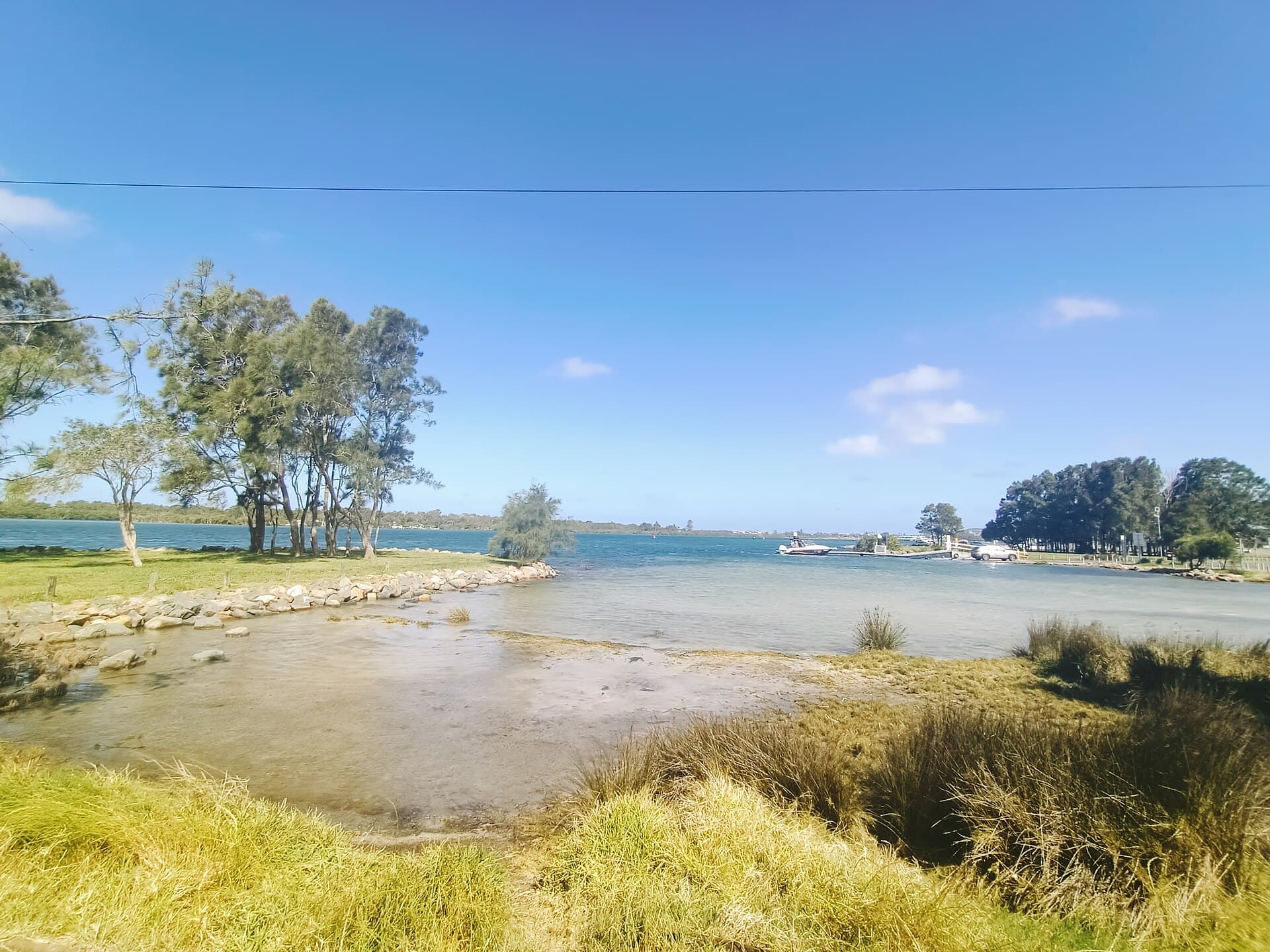
The wind at Stockton does not taste like weather. It tastes like the harbour. After a nor'-easter the cars on the peninsula wear a film you can write in with a finger, and the same film is landing, invisibly, on every balcony slab from Newcastle East around to Merewether. Concrete looks like stone. On this coast it is a porous mineral that drinks.
This is not a reason to panic, and it is not a reason to ignore the brown mark that appeared under the edge beam last winter. Coastal durability in Newcastle is a materials problem with a street address. The chemistry is the same as any other surf town. The weather, the housing stock and the way people live on the verandah are local.
What the salt is actually doing
Chloride ions are the small, patient part of sea salt. They do not eat concrete the way vinegar eats marble. They travel through the pore network with moisture, reach the steel, and break the thin passive film that normally keeps reinforcement quiet. Once that film fails, rust begins. Rust occupies more volume than the steel it replaces. The concrete cover is jacked off from the inside. That sequence — ingress, depassivation, expansion, spalling — is the whole coastal story, told slowly.
How fast it happens depends on three ordinary things: how much chloride arrives, how wet the concrete stays, and how much cover sits between the weather and the bar. A slab that dries after rain lasts longer than one that stays damp under a south-facing balcony. A member with thirty millimetres of sound cover lasts longer than one poured with the mesh on the form. Breaking waves throw droplets; wind carries them onto horizontal surfaces and into the corner where a handrail meets a slab. Rain then either rinses them off or drives them in. A dry summer followed by a wet autumn is a bad combination: salt sits, then water carries it down.
Cover, said in English
Cover is the thickness of concrete between the outside world and the nearest steel. It is not a decorative margin. It is the sacrificial skin that has to be thick enough, dense enough and intact enough to keep chlorides away from the bar for the life of the member. Australian Standard AS 3600, which we cite here as a public reference and not as a backyard design manual, sets minimum covers against exposure. An engineer on a coastal unit will often ask for more than the minimum, because Newcastle does not do the minimum weather.
On a house slab a long way inland, twenty or thirty millimetres can be a reasonable conversation. On a balcony soffit that sees spray, that number is no longer the conversation. The bar has to sit on chairs, not on the form, and the pour has to be compacted so the cover is concrete, not a honeycomb you can see from the street. If you are briefing a crew, ask where the steel will sit, not only what strength the mix is. Old coastal buildings in Newcastle East and The Hill were not poured to a modern exposure table. Age is not the diagnosis. The diagnosis is whether the steel is still inside a sound shell.
Exposure class without the mystique
Standards sort environments into classes so that a draughtsman in an office and a certifier on a site are talking about the same weather. In plain English the ladder runs from a dry interior, through ordinary outdoor air, through near-coastal weather, to the splash and tidal zone. A garage floor in Kotara is not in the same class as a balcony at Bar Beach. A driveway in Hamilton, two kilometres from the surf but still in the salt wind, sits somewhere in the middle and argues about it.
The useful homeowner version is simpler than the table. Can you smell the sea from the member on a still morning? Does spray actually wet it in a storm? Does it stay wet afterwards? If the answers are yes, you are in the serious column, whatever letter a drawing might use. If you are briefing an engineer, let them pick the class. The editorial standards for this journal are blunt: public documents are a spine, not a substitute for the person who will stamp the work.
Four beaches, four jobs
Stockton is a peninsula with water on both sides. The ocean beach throws spray; the harbour side throws a different salt, mixed with shipping and a fetch down the river. Driveways here cop sand, salt and the odd king tide. Wash them. Do not pretend a decorative sealer will do the washing for you.
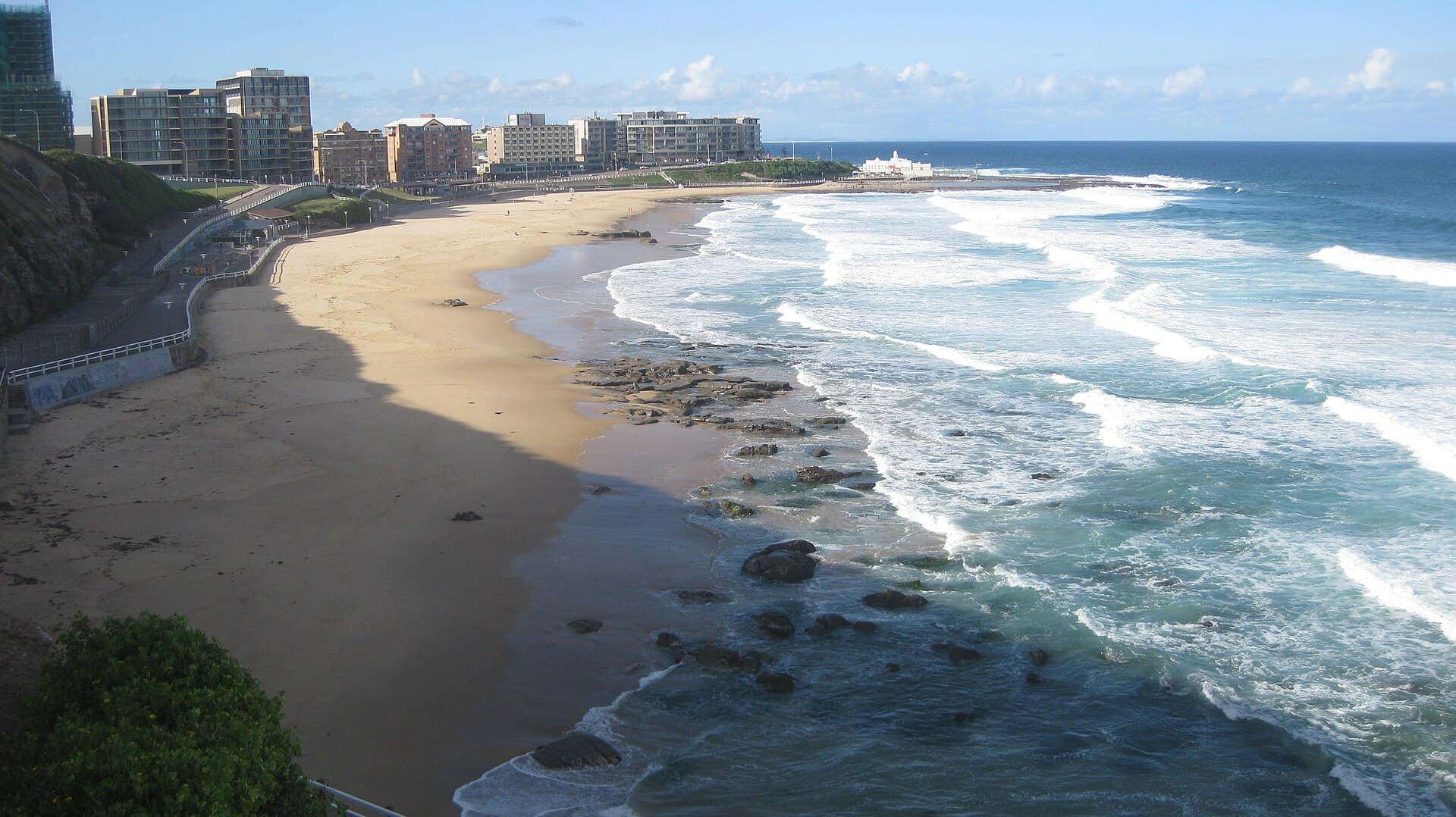
Newcastle East and the terraces under The Hill live in a wind tunnel. Balconies face the Pacific or the working harbour. A rust stain on a 1920s edge beam is heritage fabric. A stain on a 2018 unit is a question about why a new member is already talking.
Bar Beach and Dixon Park sit in the bowl where the southerly comes in hard. Horizontal surfaces — pool surrounds, rooftop slabs, planter upstands — take the weather full in the face. Vertical faces get less chloride and dry faster. That is why a wall can look fine while the slab it holds is already mapping.
Merewether, down past the baths, combines spray with a steep catch of stormwater. A driveway that falls the wrong way holds both. If you are planning a concrete driveway in Newcastle on these streets, drainage is not a civil extra. It is half the durability. A few blocks inland — Hamilton, Cooks Hill away from the cliff, Merewether Heights — the dose drops. The mistake is to use a Cooks Hill driveway as the mental model for a Stockton balcony.
Balconies are not driveways
A driveway is a slab on ground. If it cracks the usual question is movement or shrinkage, not whether someone will be standing under it when a piece falls. A balcony is a suspended member with a soffit, an edge, and often a membrane that was asked to last twenty years of pot plants. Water sits at the door threshold. Chlorides sit in the same puddle.
Treat them as different species. On a coastal driveway, wash, keep mulch off the edge, and do not cut a trench that lets water under the slab. On a coastal balcony, keep drains open, keep the membrane honest, and treat rust or hollow cover as a structural conversation. We keep the repair essays in repairs and resurfacing for a reason. A topping on a driveway is a budget decision. A topping on a balcony that is already spalling hides the evidence. If the soffit of a balcony, stair or awning is shedding, do not stand under it while you decide. Prop, fence, call someone licensed.
Washing is the unfashionable defence
A hose after a run of onshore weather does more for a coastal slab than a conversation about nano-sealers. You are removing salt before the next rain drives it in, and the sand that abrades a finish. Do it from the top down. Do not drive dirty water into the joints and call it cleaning. If you use a detergent, choose one that is not a chloride cocktail of its own.
Pressure washing is usually a worse argument on old decorative work. A turbo nozzle on a 1980s stamped patio will open the surface and give chlorides a faster road. If the slab is young, think about curing in this humid coastal climate long before washing. If it is old and stained, read the cleaning essay before you hire a whirly jet. Sealers have a place and they do not have magic. A penetrating silane can slow chloride movement in sound concrete; a film-forming sealer can gloss a driveway and then chalk. Neither replaces cover. The sealing essay is the place for product classes. Wash first, dry, then decide.
Rust stains, kept in proportion
A rust stain is a sentence, not a chapter. It can mean the steel is bleeding through thin cover. It can mean a tie wire was left too close to the surface. It can mean a steel chair was used where a plastic one should have been. It can mean the balcony railing is rusting onto a perfectly sound slab. Look at the stain, then tap around it. Hollow cover, cracked cover, or a rust bloom that returns after you clean it: those are the marks that belong with a builder or an engineer. A single tea-coloured whisker that has not grown in two winters is worth photographing and leaving in the file.
Do not smear a cementitious paint over a stain and congratulate yourself. You have made the next inspector’s job harder. Do not ignore a stain on a soffit you walk under with a pram. If you are in a sale, a strata report, or a renovation that will open a coastal edge, get the inspection done before the cosmetic work. Tiles are not cover. Grout is not a membrane.
The Pacific will keep arriving. Specify the exposure, pour the cover, wash the salt, and treat rust as a question you are willing to ask out loud. That is the coastal job, from Stockton around the baths to the last house that can still hear the surf.