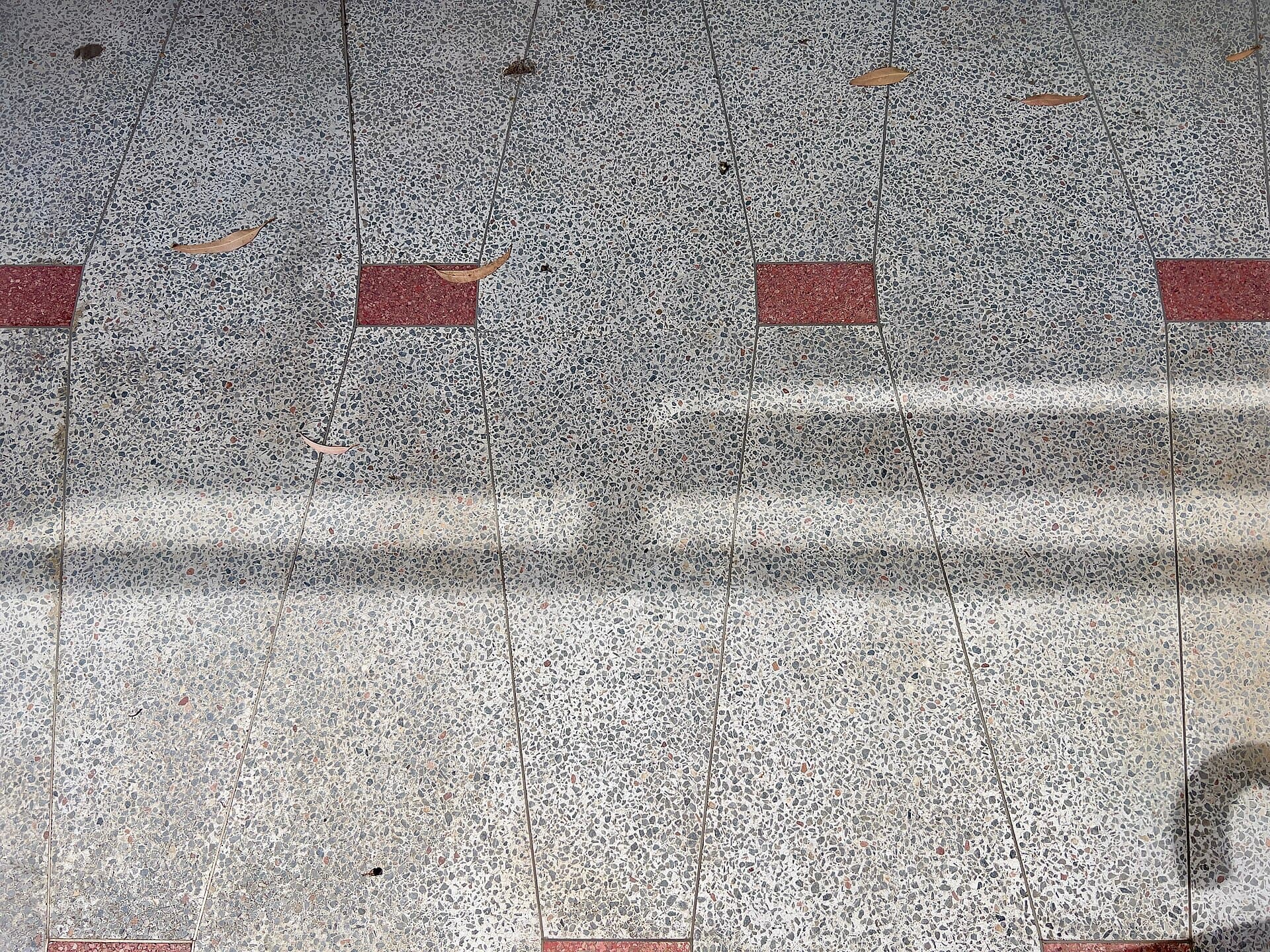
The photograph on this page is from a 1960s office building in Mascot, on the other side of the harbour city Sydney still thinks is the only one. It is here because it is the honest picture of polished concrete as a working floor: not a showroom puddle of gloss, but a ground, densified surface that has already met shoes, weather and a cleaning contract. Newcastle houses ask for the same honesty. They just ask it with beach sand in the mix.
Polished concrete is a grind, not a paint. That is the sentence that should sit at the top of every quote. This essay lives in decorative and finishes, but it keeps one hand on the slabs hub, because you cannot polish what was never a floor.
What the grit numbers actually mean
Polishing is a sequence of diamond tooling, from coarse metal-bond grits that flatten and open the slab, through transitional tools, into resin pads that refine the surface. People talk about “a 200 grit” or “an 800” as if the last pad were the product. The product is the whole sequence, plus the densifier, plus the guard, plus the slab you started with.
Cream, salt-and-pepper, stone
In domestic language the looks run roughly like this:
- Cream. The grind stays in the paste. Little aggregate shows. Quiet, even, a bit like a well-trowelled slab that went to finishing school. Forgiving of a messy original pour.
- Salt-and-pepper. You just cut into the fine aggregate. The floor starts to read as stone. Most coastal renovations that want “polished concrete” mean this.
- Exposed aggregate. A deeper cut. River gravel or a specified decorative stone becomes the picture. Beautiful in a new pour designed for it. A gamble on an old slab whose stone you have never seen.
The last grit — 200, 400, 800, 1500, the vanity 3000 — is sheen as much as exposure. Higher numbers, well executed, give a tighter, more reflective surface. They also give you every sandy footprint from Dixon Park and every nose-print from the kelpie. In a Merewether house that lives with the door open, satin is not a compromise. It is the finish that still looks like itself on a Sunday.
Ask for a sample bay, not a number. The same grit on a creamy house slab and on a stony warehouse leftover will not be cousins.
Densifiers, guards and the chemistry underfoot
A densifier — typically a lithium, sodium or magnesium silicate — soaks into the open surface and reacts with free lime to harden the skin. It is why a polished floor can take traffic without dusting. It is not a sealer in the film sense. Water will still darken a densified floor. A stain will still sit if you let red wine dry in a saw cut.
Guards and impregnating sealers are the next layer: a thin, often sacrificial, protection that makes cleaning possible. They wear. They can be refreshed. They are the difference between a floor that shrugs off a winter of wet dogs and a floor that maps every walk from the beach.
Sealing as a general practice is a different essay. On a polish, the rule is: densify for the stone, guard for the life, and do not pile three incompatible products because a hardware aisle was persuasive. If the floor will take a topical colour — a dye in the grind sequence — that decision belongs with oxides and stains and with a contractor who has done both in this climate.
Salt, sand and the path from the beach
Coastal houses import the beach. It arrives in togs, in a kid’s scalp, in the pile of shoes that never quite makes it to the rack. Sodium chloride is not only a rust story for the steel in the slab. On a polished floor it is grit and a moisture magnet. Salt sits, pulls damp from the air, and leaves a dull ring. Sand scratches a guard the way it scratches a table.
The architectural reply is boring and effective. A grate or a recessed mat at the beach door. A second mat. A household rule that sandy towels do not hit the polish. A mop that is not a grit-loaded rag. None of this is a failure of the floor. A polished slab in Stockton that is treated like a hotel lobby in the city will look tired in a year. The same slab with a grate will look like the Mascot office: used, and still itself.
Do not wash a coastal polish with seawater, and do not use a cheap acidic cleaner because the floor “looks like stone”. It is concrete. Acids etch. The etch becomes a pale map that no densifier will re-close.
Dogs, claws and the honesty of a working floor
A polished slab is kinder to paws than a cheap floating timber, and crueler to the owner’s vanity than a mid-grade carpet. Claws click. They do not usually gouge a densified salt-and-pepper floor. They will mark a soft guard, and they will leave a traffic lane that becomes visible in raking light — the same raking light a winter afternoon throws across a Cooks Hill terrace.
If the household has dogs, specify satin, accept the traffic lane, and put a rug where the afternoon wait happens. Rugs on polish need a non-staining underlay. Rubber-backed cheapness yellows. That is not the slab’s fault either.
Urine is the chemical to respect. It is acidic enough, left in a saw cut, to etch. Clean it as a matter of habit, not as a weekend project.
Winter condensation, and the floor that sweats
Newcastle winters are mild until they are not. A polished slab is a thermal mass. On a clear July night the slab can sit below the dew point of a humid morning, especially in a house that was opened to the nor-easter the evening before. The floor sweats. People say the slab is leaking. It is the air, condensing.
The reply is ventilation, a little heat, and not treating the morning film as a sealer failure. On a new pour, a slab that is still drying from the inside can add real moisture to this picture. Cure first — Helen Crowe’s curing essay — then let the slab dry to a level the polisher will measure, then grind. Inverting that order traps moisture under a tight surface and gives you a cloudy winter.
Condensation also makes the floor slippery. Satin helps. Rugs at the kettle help. A dehumidifier in a tight beach cottage helps more than a third coat of guard.
The acoustic feel people forget to mention
Polished concrete sounds like itself. Hard shoes, hard wheels, a dropped pan, a conversation that no longer dies in the carpet. In an open Merewether plan with a hard ceiling this can be lively or it can be a can. Softness has to come from somewhere: timber furniture, a decent rug, curtains that actually close, a cork underlay in the one room you care about.
This is not a reason to avoid the finish. It is a reason to budget the room, not only the grind. People who grew up on timber and then polish the whole ground floor are often surprised on the first wet Tuesday. Walk a finished house, not only a sample tile in a showroom, before you commit the ground plane.
Existing slab versus new pour
A new pour designed to be polished is the calm job. The engineer and the concreter know the floor will be seen. They will talk about a mix with a decent stone, a finish that is flat, a curing method that does not leave a compound the grinder has to fight, and joints that have been thought about as lines in a room. Integral oxide, if you want colour through the paste, goes in the truck. Cover to the mesh is not a place to save ten millimetres. A mesh that prints is a feature you cannot unsay.
An existing slab is archaeology. Oil from a former garage. Patching from a former kitchen. A doorway where two pours met and curled. A waffle topping that goes cream-cream-stone as the pods telegraph. Glue from a vinyl that someone “mostly scraped”. Rising moisture in a house that never had a membrane. You grind a wardrobe, a future pantry, a bay behind the future fridge. If the sample is a circus, the living room will be a circus with sofas.
Sometimes the honest finish on an old coastal slab is a microtopping or a well-chosen resilient floor, not a polish. That is not a defeat. It is a refusal to pay for a high-gloss map of 1978.
Joints remain. Polishing does not delete shrinkage. Hairlines that were acceptable under carpet become drawings. Read hairline versus structural if a crack is doing more than sitting still. Fill what should be filled, express what should be expressed, and do not let a polisher sell a “crack-free grind” on a thirty-year-old Hunter raft.
A polished floor in a coastal house is a working surface that happens to be beautiful when the household meets it halfway. Specify the look with a sample, keep the beach at the door, densify rather than varnish, and let the Mascot photograph be the standard: a floor that has a job, and still takes the light.