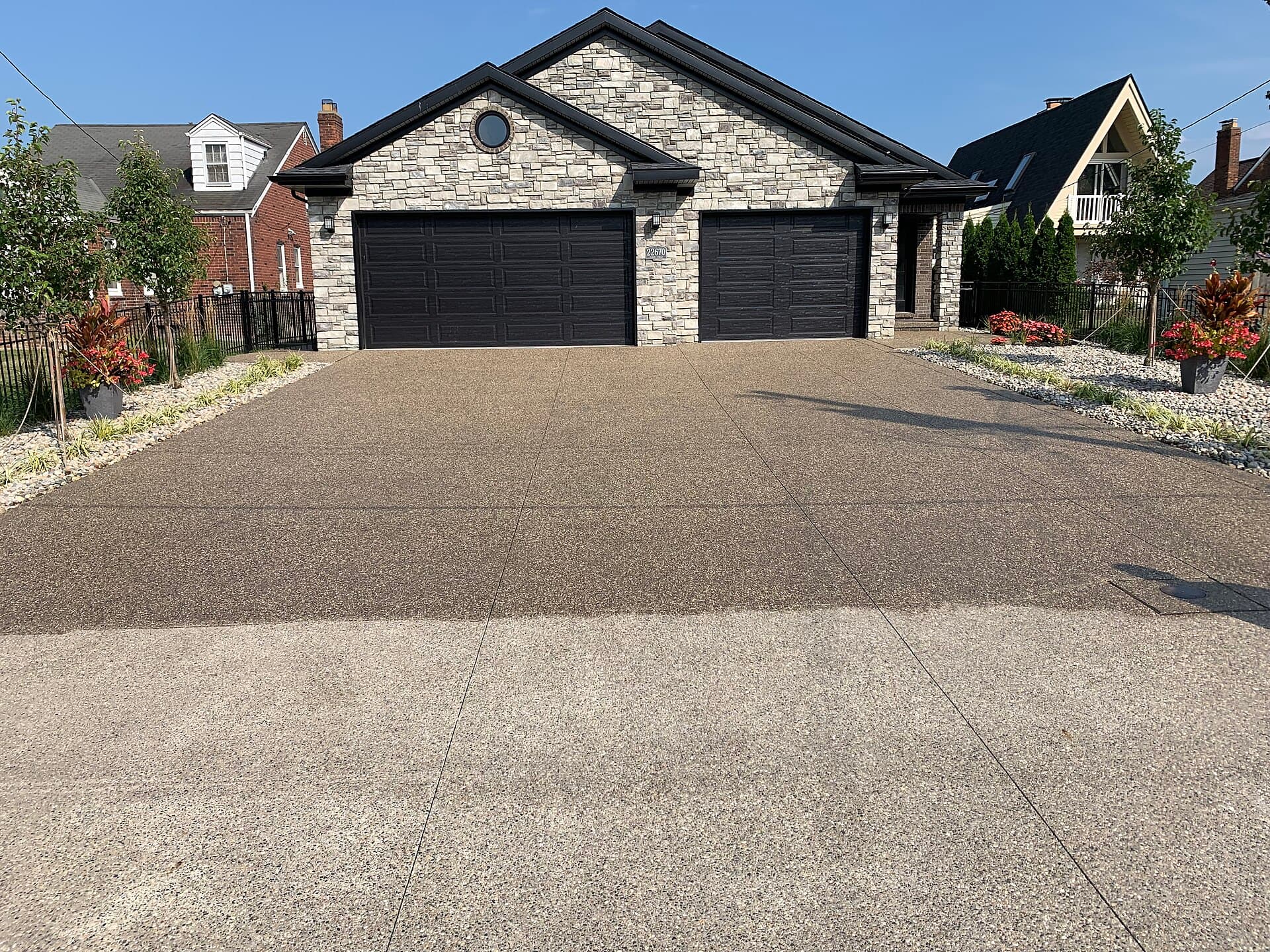
A Hunter courtyard is a small climate. Brick walls hold the heat. A frangipani drops a film that turns to slime. A nor-easter finds the gap between the terrace and the lane. Into that climate people pour a slab and then, quite reasonably, ask it to look like stone.
Stamped concrete is the honest industrial answer to that wish. It is also a finish with a memory: every shortcut on the day, every sealer that was left a year too long, every repair after a plumber’s trench, stays visible. This essay sits in decorative and finishes because the structural argument should already be over. If the courtyard is moving, read the slabs hub before you pick a pattern.
Stamp versus pavers, as a job not a mood
Pavers are a kit. They can be lifted. They have joints that drain if someone designed them to. They accept a later change of mind. They also settle in clay, grow moss in Hamilton shade, and migrate on a poorly compacted bed until the stringline is a suggestion.
Stamped concrete is a monolith with a picture on it. Colour the plastic concrete, dust or wash a release, press patterned mats, wash, sometimes antique, and seal. You get one plane with fewer ant highways and fewer trip edges. You give up the right to lift a square and start again.
Choose stamp when the courtyard is a defined room — Cooks Hill terrace, Hamilton cottage, a tight Merewether side return — and you want a simple fall and no paver lips. Choose pavers when a plumber will be back, when you do not trust the ground, or when you may change the picture in ten years. A hybrid is often wise: a stamped field with a soldier edge that can be lifted against the house.
A cheap stamp is a slab with a cartoon on it. Price the base, the fall, the sealer cycle and the repair path.
How a stamp is actually made
The hour you cannot get back
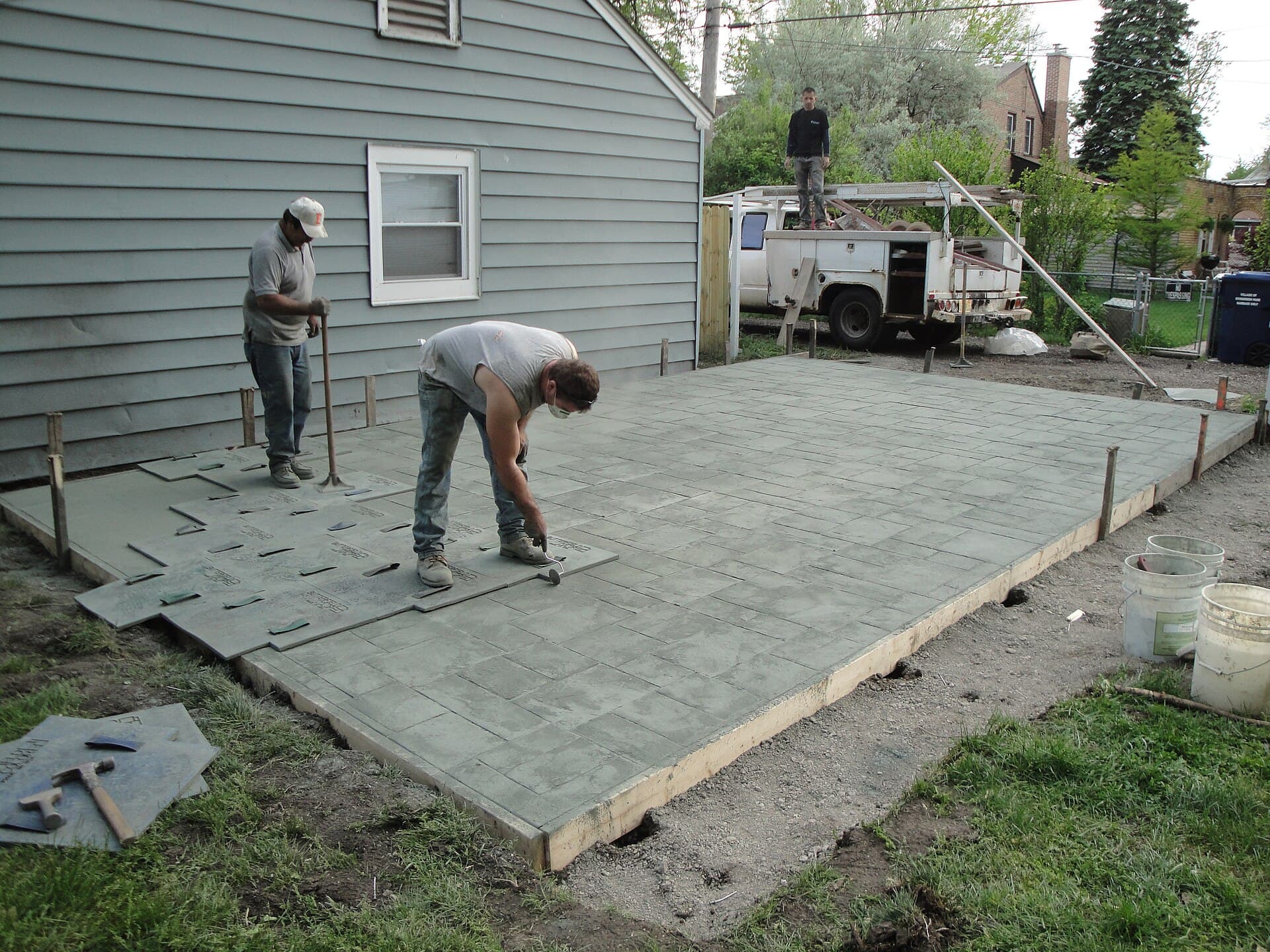
The day has no pause button. Place, screed, float. Colour goes in as integral oxide, as a broadcast hardener, or both. Release — tinted powder, sometimes liquid — keeps the mats from sticking and leaves antique in the recesses. Mats go down so the “stone” does not repeat like cheap wrapping paper. A hand-stamp does the edges. Then wait, wash to the depth you meant, and seal when the moisture says so.
Each of those verbs can fail. The usual list:
- Integral colour without a hardener looks thin once washed.
- Hardener without coverage mottles.
- Heavy release stays dusty; light release lets the mats tear the skin.
- Early washing pulls colour; late washing leaves a greasy antique.
- Early sealing clouds; late sealing locks in laitance.
A stamp is chemistry plus a clock. Miss one hour and the picture publishes the miss.
Sample panels matter more for stamp than for almost any other domestic finish. A 600 mm square, same mix, hardener and release, left on the actual site for a week, will save a marriage. Coloured concrete, oxides and stains is the chemistry lesson. Stamp is that chemistry plus a clock.
Release agents, and the antique you cannot unsee
The release is the shadow in the joints. It is why a stamp looks like stone instead of like a waffle iron. Powdered releases are still the yard standard. They are messy. They stain brick, aluminium and the neighbour’s white dog. Masking is not optional on a Cooks Hill terrace where the courtyard is 800 mm from a Victorian sash.
Liquid releases are cleaner and can be easier on later sealing. They do not always give the same depth of antique. Crews have preferences. Owners have neighbours. Agree which one before the day, and agree who is washing the brick.
The antique will fade at a different rate from the field colour. That is normal. What is not normal is a blotchy wash that left half the courtyard with a mud-coloured skin. You cannot sand that off without losing the stamp. You live with it, or you overlay, or you start again. There is no polite third option.
Colour fade in this light
Newcastle light is hard. It is a coastal glare off the water and a high summer sun that sits on a north courtyard as if the courtyard had asked for it. Iron-oxide colours — the reds, browns, ochres, the “sandstone” palette — hold better than organic pigments. Blues and some greens are vain hopes in full sun. A charcoal stamp in a Merewether side yard will still fade toward grey; it will just fade with more dignity.
Sealer is not sunscreen forever. A solvent acrylic that looked wet and rich at handover will chalk and yellow. A worn sealer is glossy in the traffic line and matt at the edges, which makes the fade look worse than it is. Recoat on a cycle — two to four years in full sun, longer in a shaded Hamilton garden — and strip when the film has become a laminate. Sealing concrete is the longer maintenance essay. For stamp, the short version is: the picture is only as good as the film, and the film is a consumable.
Ultraviolet is only one thief. Leaf tannin, barbecue fat, and the pink oxide dust that blows off a renovated terrace will all stain a porous stamp whose sealer has died. A courtyard under a jacaranda is a different product from a courtyard under a sail.
Slip, shade and the January hose
A deep ashlar or slate texture has inherent grip. A worn, heavily sealed surface does not, especially once the frangipani has done its work. Shady Cooks Hill and Hamilton courtyards stay damp. Algae is a finish, unfortunately. A light pressure-wash and a sealer with some grit are maintenance, not admissions of defeat.
Lake Macquarie courtyards add glare off the water and a breeze that dries the surface just enough to make the next rain a surprise. Warners Bay and Toronto pads that take boat gear want more grip than a magazine “limestone”. Ask for a sample you can wet and stand on in socks.
Falls still matter more than pattern. A stamp does not drain through its joints. The slab must fall to a pit or to the garden, at a gradient you can feel with a marble. Ponding on a stamped courtyard is a brown map. Outdoor entertaining areas takes the drainage and furniture argument further. Here it is enough to say: the prettiest slate pattern in a puddle is a puddle.
Repairs that never quite match
A plumber will one day cut your courtyard. A tree root will lift a corner. A moving van will take a chip out of a step. The repair will be visible.
A good repair uses the same mats if they still exist, the same colour codes if anyone wrote them down, and a joint that frames the new work as a panel. Even then the colour is a cousin. Oxides vary by batch. The original has weathered. The antique cannot be brushed on in a way that fools anyone at 4pm.
Design for this. Put a soldier course where you expect a trench. Keep a labelled leftover of hardener. Photograph the codes. If the household cannot accept a cousin, do not stamp the field over the sewer.
On reactive clay a stamp has no extra magic. The slab still moves. The pattern will crack along the same lines an unstamped slab would have cracked, only now the crack runs through a fake stone joint or, worse, through the middle of a fake stone. Joints in the stamp pattern are not control joints. Cut real ones and try to hide them in the pattern lines. That is craft.
Cooks Hill, Hamilton, the lake
A Cooks Hill courtyard is often a room with a sky. The neighbours are close. The brick is old. Release stain on a shared wall is a diplomatic incident. Choose quieter colours — the sandstone and tobacco range — and a smaller stamp that does not shout at the terrace. Keep the sealer off the brick.
Hamilton has plane trees, shade and a Saturday trade in coffee. Organic debris is the enemy. Texture and a maintenance habit beat a glossy magazine finish.
Lake Macquarie work wants glare control and grip, and it wants a fall that does not send stormwater into the lake as a sheet of sealer-tinted runoff. Council mood on that subject is not theoretical. A simple, well-fallen stamp in a mid ochre, sealed with something you are willing to renew, will outlast a three-colour “random stone” that was fashionable the year of the pour.
Stamped concrete is not fake stone. It is concrete that admits it is a picture, and then has the manners to keep the picture for a decade if you feed the sealer. Commission it like a finish, not like a bargain slab. The Hunter light will do the rest of the editing.